
Teledyne LABS Releases Two New and Improved Diffusion Cell Testing Systems
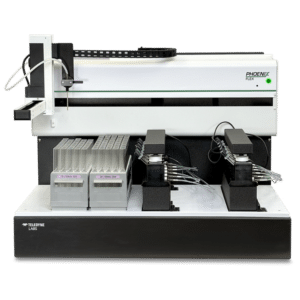
In its ongoing commitment to innovation and new product development, Teledyne LABS is launching two new diffusion cell testing instruments, the DB-Max diffusion cell block and the automated Phoenix Flex diffusion tester. Both are 21 CFR Part 11 compliant and yield precise, reliable results in an easy-to-use platform.
The DB-Max uses manual sampling methods in a six cell block for release-rate and permeation testing of six vertical diffusion cells. Controlled by an advanced computerized display, the DB-Max provides uniform heating and stirring of the six cells. The DB-Max can be integrated into two Teledyne LABS automated diffusion testers, the Phoenix RDS and the new Phoenix Flex.
The Phoenix™ Flex dry-heat diffusion tester was designed specifically to meet USP <1724> and FDA requirements of full media replacement or large aliquot replacement for IVPT studies. It includes one or two cell blocks to provide six or 12 cells; the Phoenix Flex tilts the cells to eliminate bubbles during filling or sampling from the cells. Other features include integrated temperature sensors for media in the cells, replacement media and membrane temperature monitoring throughout the run, and a robotic platform that automates the sampling process.
The system runs on 21CFR Part 11 compliant Diffusion Master software, a Windows-based workstation that can control and document two Phoenix Flex systems in tandem, for an unattended run of up to 24 diffusion cells. A feature unique to this system in the marketplace is the ability to collect T=0 samples prior to dosing the membrane, and software able to enter membrane integrity data, which is recorded in one test report.
“Diffusion-cell permeation/absorption testing of topical products has historically been cumbersome, time-consuming and subject to inconsistencies due to procedural variances,” said Hector Bucaro, product line manager for Teledyne LABS’ Hanson brand of diffusion and dissolution testers. “Thanks to the Phoenix Flex, running IVPT is easy and less prone to operator-biased errors. The gains in precision, consistency, cost-savings and lab capacity throughput are significant.”
Teledyne LABS has been an innovator in diffusion cell testing since Hanson released its groundbreaking Microette diffusion testers over 25 years ago. The Microette was the first automated Vertical Diffusion Cell (VDC) available anywhere. The VDC was developed in collaboration with the U.S. Food and Drug Administration and signified a tremendous stride within the scientific community. It was later adopted as the “Model A” into USP <1724>.
“Our rich history of well-built, precise, easy-to-use products actually began with our modified Franz cell, patented in 1980,” Bucaro said. “We built on the Microette’s solid foundation to eclipse that milestone with our automated, computer-controlled Phoenix™ RDS d ry‐heat system and now the even more robust Phoenix Flex.”
The Teledyne LABS website, www.teledynelabs.com, contains details on the many features and benefits of the DB-Max at www.teledynelabs.com/products/diffusion/phoenix-db-max. The Phoenix Flex contains a long list of technical and operational advancements as well. A thorough description is at www.teledynelabs.com/products/diffusion/phoenix-flex.
“For a firsthand look at the DB-Max and Phoenix Flex, our application team can host an exclusive virtual demo at the date and time convenient to anyone interested,” Bucaro said. “We’ll present a quick walkthrough, answer specific questions and offer a special discount just for attending.” Contact your local Teledyne LABS diffusion products representative or Teledyne LABS directly to schedule a one-on-one virtual demo.
