
Nanion and Elements Srl announce collaboration powering next-generation Patchliner platforms with advanced amplifier technology
Nanion Technologies GmbH
Munich, Germany
Following several years of close collaboration, Nanion Technologies and Elements are proud to announce the successful integration of Elements’ cutting-edge microchip-based amplifier technology into Nanion’s newly launched Patchlinere and Patchlinerm platforms.
Driving innovation in electrophysiology
Nanion has long been committed to advancing automated patch clamp technologies to accelerate drug discovery and basic research. The integration of Elements’ multichannel microchip amplifiers into the Patchlinere and Patchlinerm systems enables a new level of miniaturization and performance, reducing system footprint while maintaining exceptional signal quality.
Elements brings over a decade of experience in designing low-noise, high- bandwidth amplifiers for demanding applications such as nanopore measurements and electrochemistry. Their custom ASIC technology (CMOS silicon microchip) allows multiple channels to be recorded independently without multiplexing, ensuring high data fidelity and throughput.
This collaboration reflects a broader shift in the electrophysiology field – from traditional discrete-component electronics toward highly integrated, application-specific solutions that improve usability and experimental efficiency.
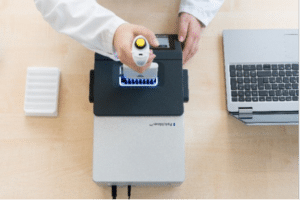
The newly developed Patchlinerm combines Elements miniaturized amplifiers in a sma l and easy-to-use automated patch clamp instrument.
A long-standing collaboration
The partnership between Nanion and Elements builds on a long history of scientific exchange and joint development. Early collaborations contributed to successful products such as the Orbit mini, which combined Elements’ ASIC technology with Nanion’s expertise in bilayer recordings.
Over nearly four years of intensive joint R&D, including technical visits, prototyping, and iterative optimization, the two teams have worked closely to bring the new Patchliner generation to the market.
Federico Thei, CEO of Elements, reflects on the collaboration:
“After years of development, we are thrilled to see our latest multichannel patch-clamp ASIC technology successfully integrated into the new Patchliner family. This achievement demonstrates how deeply integrated CMOS electronics can transform electrophysiology, enabling powerful yet compact systems designed for the future of research.”
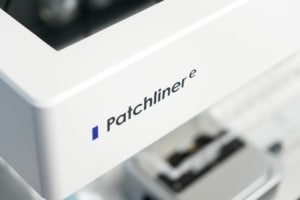
The Patchlinere with integrated amplifiers from Elements is the next generation of fu ly automated patch clamp instrumentation in Nanion’s portfolio.
A shared vision for the future
Nanion’s CEO, Niels Fertig, commented on the launch and collaboration:
“The development of the new Patchliner platforms marks an important milestone for Nanion. By integrating advanced amplifier technology from Elements, we are enabling a new generation of electrophysiology instruments that combine performance, usability, and scalability. This collaboration highlights what can be achieved when expertise in microelectronics and biophysics comes together.”
The joint effort underscores both companies’commitment to continuous innovation and close collaboration with the scientific community to address emerging research challenges.
About Nanion Technologies
Nanion Technologies is a leading provider of instrumentation for ion channel drug discovery and screening. Founded in 2002, Nanion has grown over the last 22 years to a company with over 120 employees worldwide. Nanion’s team has developed and successfully established four generations of APC instruments along with further product lines for cell monitoring and toxicity screening, parallel bilayer recordings, and membrane transporter protein measurements.
About Elements Srl
Elements develops advanced microelectronic solutions for electrophysiology, nanopore, and electrochemical applications. Since 2014, the company has specialized in custom ASIC design for low-noise, high-performance measurements, enablingnext-generation instrumentation across a range of life science applications
