
Release of the High-Sensitivity Cryogenic Probe “SuperCOOL MARVEL HCN,” Optimized for Biomolecular NMR
JEOL Ltd. (President & CEO Izumi Oi) announces the release of “SuperCOOL MARVEL HCN,” a new liquid-nitrogen-cooled cryogenic probe for Nuclear Magnetic Resonance (NMR) spectroscopy.
The probe offers triple-resonance capability (1H/19F, 13C and 15N), making it suitable for a wide range of biomolecular applications. The initial release is for 600 MHz NMR systems. Sales are scheduled to begin in August 2026.
High-Sensitivity Triple-Resonance Probe for Biomolecular Analysis
SuperCOOL MARVEL HCN is a newly developed liquid-nitrogen-cooled cryogenic NMR probe. It is part of the SuperCOOL MARVEL series launched in 2024, which features the latest RF electronics design, optimized for cold probes, and delivers a significant improvement in signal sensitivity. The HCN version inherits this technology and expands the probe’s triple-resonance capability to 1H/19F, 13C and 15N nuclei. The probe is well suited to measurements of protein, peptide and nucleic acid samples, which are attracting considerable attention in the life sciences.
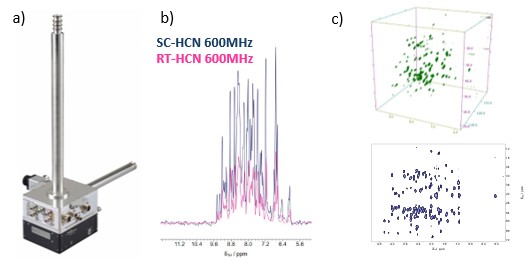
Figure 1. a) SuperCOOL MARVEL HCN probe. b) Overlay of 1D 15N HSQC spectra (4 scans) of uniformly 13C/15N-labelled 0.35 mM ubiquitin, acquired with the SC MARVEL HCN (blue) and RT-HCN (magenta) probes. c) 3D CBCA(CO)NH spectrum (8 scans, experimental time = 2.0 h, NUS = 12.5%) of the same sample, shown as a cube representation and an F2-axis projection onto the F3–F1 plane.
Main Features: Higher sensitivity at lower cost
1) Triple-resonance experiments (1H/19F, 13C, 15N) with high sensitivity
SuperCOOL MARVEL HCN is a triple-resonance probe optimized for 1H/19F detection, with 2H decoupling capability. It includes dedicated cold preamplifiers for both 1H/19F and 13C nuclei, delivering a 2- to 3-fold sensitivity improvement for these nuclei compared with our standard room-temperature HCN probe. A pulsed field gradient of 60 G/cm can be applied with a 10 A current. This setup enables highly efficient biomolecular NMR experiments.
2) Open cooling system
This product uses an open-circuit cooling system, with a one-way flow of liquid nitrogen to cool the RF coils and preamplifier. With this cooling system, refilling the liquid nitrogen reservoir does not interfere with ongoing NMR experiments, allowing users to schedule experiments without interruption for coolant replenishment.
The energy consumption of the cooling system is significantly lower than that of conventional helium-gas-circulating cryogenic systems. Together, the improved acquisition efficiency and reduced initial and running costs allow the system to offer excellent cost performance compared with helium cryogenic probes.
Links
